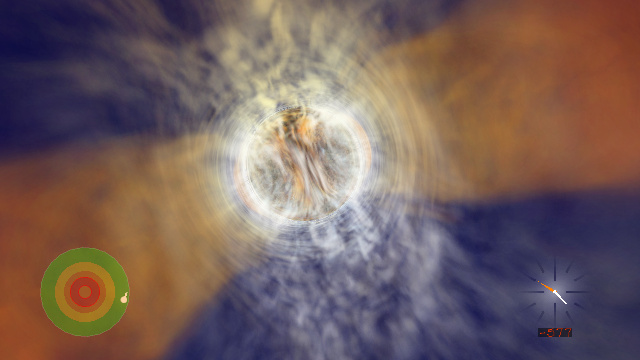
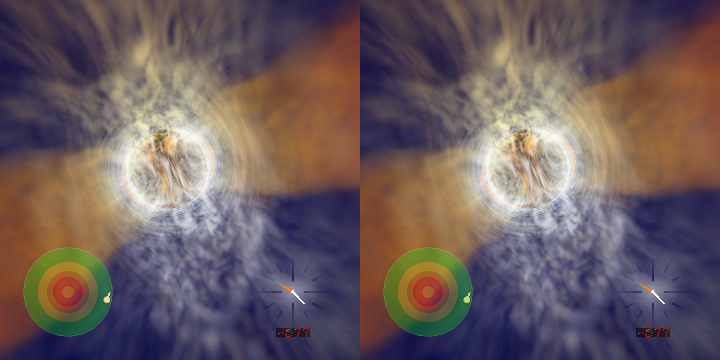
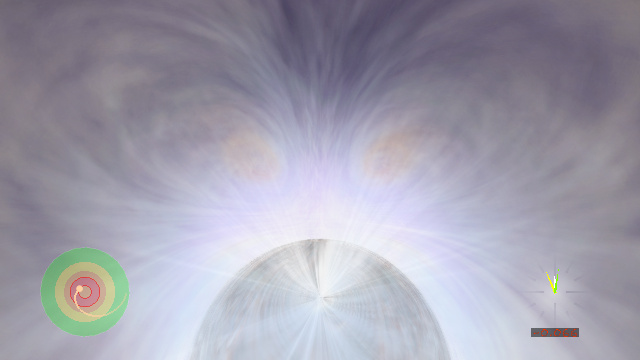
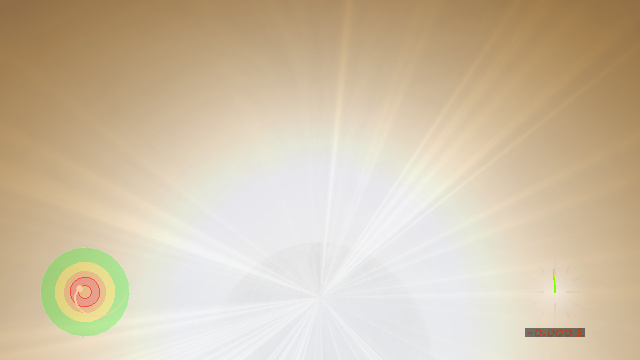
Journey into a realistic black hole.
This journey into a black hole
is a general relativistic volume-rendering with the BHFS
of a general relativistic magnetohydrodynamic simulation of a disk and jet
supercomputed by John Hawley at the University of Virginia.
The movie is similar to one I did for the NOVA documentary
“Monster of the Milky Way”,
which premiered on PBS in 2006.
The black hole
is intended to model the
4 million solar mass
supermassive black hole at the center of our Galaxy, the Milky Way.
The clock shows your proper time,
in seconds until vaporization by the inflationary instability at the inner horizon.
The tidal force from the supermassive black hole is weak enough
that you can survive all the way down to the inner horizon without being torn apart.
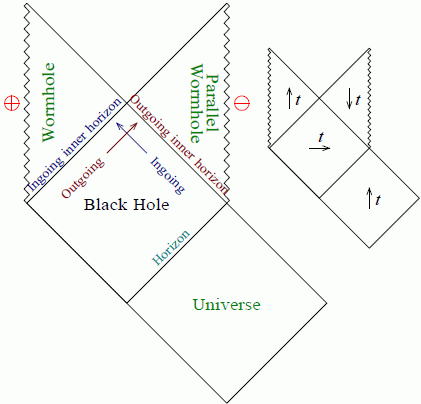
Penrose diagram illustrating the cause of mass inflation
The infinite blueshift at the inner horizon
of the Reissner-Nordström geometry was first pointed out by
Roger Penrose in 1968
1.
Penrose suggested that the infinite blueshift would destabilize the Reissner-Nordström geometry.
The full nonlinear character of the instability at the inner horizon
was eventually clarified in a seminal paper by Eric Poisson & Werner Israel in 1990
2.
The instability, which Poisson & Israel dubbed “mass inflation,”
is caused by relativistic counter-streaming between ingoing
(positive energy) and outgoing (negative energy) streams
near the inner horizon
3.
Between the outer and inner horizons,
the radial and time directions in a sense exchange roles.
Whereas outside the horizon you are compelled to go forwards in time
but you can go either inward or outward in radius,
inside the horizon
you are compelled to go inwards in radius
but you can go either forward or backward in the time coordinate
(the special time coordinate that expresses the
time translation invariance of the black hole geometry).
The inner horizon,
where the inflow of space slows back down to the speed of light,
is a place where the radial and time directions would like
to revert to their usual roles.
This produces an impasse,
because ingoing (positive energy) particles want to fall into
a place where coordinate time is going forwards,
while outgoing (negative energy) particles want to fall into
a place where coordinate time is going backwards.
But time cannot go simultaneously forwards and backwards.
Attempting to drop through the inner horizon,
ingoing and outgoing particles attempt to exceed the speed of light
relative to each other.
As its Penrose diagram shows,
in the Reissner-Nordström geometry
ingoing and outgoing geodesics do in fact exceed the speed of light
relative to each other,
and cross two distinct inner horizons
into two causally separated regions,
the
“Wormhole” and “Parallel Wormhole”
regions.
The Reissner-Nordström geometry assumes that the black hole is completely empty.
But if the black hole contains even the tiniest amounts of ingoing
and outgoing matter near the inner horizon,
then it is impossible for the ingoing and outgoing streams
to exceed the speed of light relative to each other.
As the streams race through each other ever faster,
eventually the pressure produced by the counter-streaming
begins to produce a gravitational force that competes with the native
gravity of the black hole.
The gravitational force is inwards, to smaller radius,
but the inward direction is in opposite directions
for ingoing and outgoing streams.
Thus the gravitational force produced by counter-streaming pressure
acts so as to accelerate the streams even faster through each other.
The result is an exponentially growing instability:
the counter-streaming pressure produces a gravitational force
that accelerates the streams faster, which increases the pressure,
which increases the force, and so on.
The inflationary instability acts like a particle accelerator of
extraordinary ferocity.
Whereas the streams of a terrestrial particle accelerator are
accelerated by electromagnetism,
the streams of the black hole particle accelerator are self-powered
by the gravity produced by their own counter-streaming.
The black hole particle accelerator easily reaches and exceeds
energies comparable to those in the Big Bang.
What does Nature do with such a machine?
The above statements refer to a spherical charged black hole,
but the same arguments probably apply
to the more realistic case of a rotating black hole,
whose Penrose diagram is quite similar.
Unfortunately, the problem is difficult,
and little research has been done on the inflationary
instability inside a rotating black hole.
Note added Oct 2011:
I have been making some progress on the problem lately
4,5.